
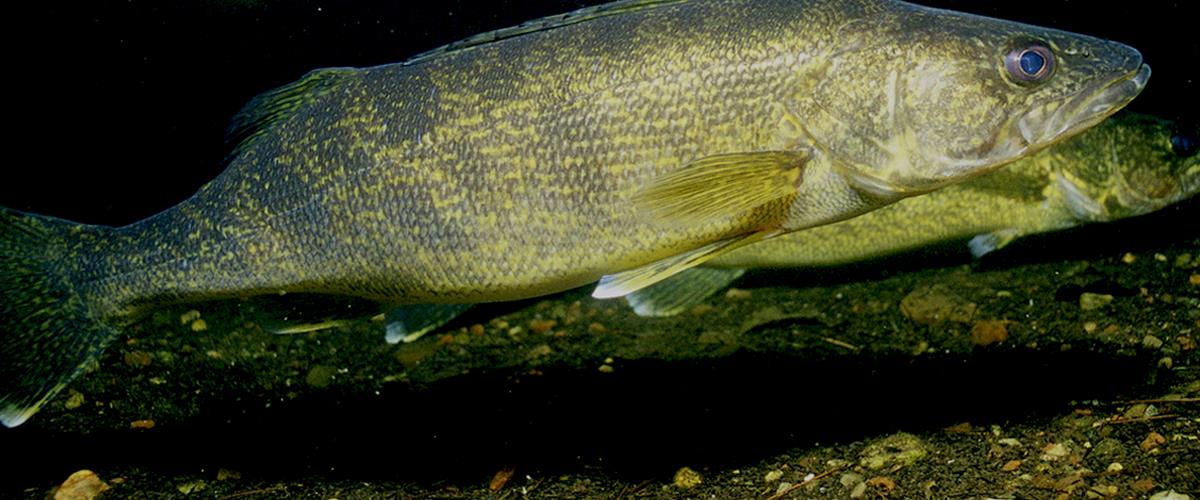
Thousands of walleyes leave their spawning grounds on the Batiscan River to go feed in the St. Lawrence River each year. Being a smart fish, this fierce opponent offers anglers a very sporty fishing experience. Bruno Morency, who has been a fishing guide for 21 years has made it is his main occupation. Here are his tips to get started with this fun and challenging fishing experience.
The walleye : a home-loving animal
Since the walleye is highly intolerant to sunlight, it usually stays around the piles of branches and rocks that litter the river bottom. Its submarine hideouts protect it from sunlight and from the anglers' fishing lines. You have to convince the fish to come out of its hideout. "We must stimulate the walleye's senses. That's what makes this fishing so interesting. We have to work to catch our fish," explains Mr. Morency.
Noise, vibration, and colour are an angler's best friend.
An aquatic racket
"The goal is to scrape and hit the bottom of the water with noisy and colourful baits," says Mr. Morency. To do so, two types of rigs should be in the walleye angler's box: swimmers and bottom bouncers.
A bottom bouncer is a very simple apparatus, including a leaded metal rod folded at a 90-degree angle that emits vibrations by hitting the bottom, while presenting an attractive rig (a worm, a floating swimmer bait or a simple jig).
Sinking swimmer baits are an even simpler solution, particularly rattling models, which include noisy lead beads.
More expensive than the bottom bouncers, swimmers are however lighter, thus better adapted to children and cheaper fishing rods.
Bottom bouncers require sturdy lines and rods. "With a swimmer bait, a fishing rod designed for trout is sufficient, but as soon as a bottom bouncer is added to the set-up, you need a more rigid rod (medium-heavy), because a medium-light cannot support the extra weight," explains Mr. Morency.
"As for the line, I recommend using a braided or fused line with a minimum 14 to 20 pounds test," adds the expert. Less elastic than monofilaments, braided lines allow you to feel all the vibrations.
Fishing the Quebec walleye
It is by dragging their line at the bottom of the river on the walleye's hunting territory that anglers will manage to convince the fish to bite the bait.
If walleyes bite swimming baits with a ferocious strike, they prefer sucking on worms and certain jigs, denying anglers the typical vibrations experienced with trout fishing. The irregular bottom of the St. Lawrence also misleads the senses of walleye teasers.
This method of trolling therefore requires a lot of attention: "Often, when I tell people they have a walleye at the end of their line, they admit not having felt the bite. It's not easy!" exclaims Mr. Morency.
The guide is unequivocal: fishing walleye is not easy, but the personal challenge and the fish make the effort worthwhile. With the proper equipment and the good technique, even the least experienced beginner can easily fill their basket on the St. Lawrence River.
Even though he is not the greatest fighter found in our waters, some will argue that walleye does not give its place for the amazing quality of it white and flaky flesh. Since this species is available very close to us (in the St. Lawrence, among others), why not try the experience and catch a few?
As this is an introduction to the fishing of this species, I will spare you the scientific details related to its lifestyle, and I will stick to basic tips. However, for more details, do not hesitate to come and meet us at the Fishing Department.
First of all, the walleye is a lucifugous fish, which means that it flees from light. It is therefore easier to catch during periods of low light, but this is not to say that it never bites during the day, quite the contrary. All you have to do is to find the structures where it hides during these periods. A steep chain of rocks is generally the walleye's preferred habitat, and that is where you will have to look for it.
When it comes to equipment, there is no need to make life difficult for yourself. A monofilament line with a resistance of 8-10 lbs and a traditional trout rod will be sufficient. You will, however, have to invest a few dollars in lures. Walleye is a predator that is attracted by crayfish or minnow decoys and by jigs—these rubber pieces with seemingly incongruous shapes. A handful of jigs (which are, let's say, very inexpensive) of various colours (think of the classics: yellow, white, chartreuse, black and brown) equipped with 3/8 oz. jigheads should be enough for you to catch your first walleye. Add to this a few swimmer baits (Rapala, Yo-Zuri or others) to vary the presentation, and you are ready for an adventure! (Allow me to add that we never use steel leaders when fishing walleye unless pikes are present on the same water body. Moreover, you should ONLY use leaders with swimmer baits and NEVER with jigs.)
The basic technique is very simple. Since walleye is a gregarious fish (which lives in groups), you should concentrate your initial efforts on locating a school. To do so, if you are on a boat, simply troll a swimmer bait along the structures present. As soon as you catch a walleye, note the exact place where it bit and return immediately. It is important to note this specific place with precision, since it is very likely that one single stump or rock shelters your fish's entire family. Being a mere 30-40 feet away could significantly reduce your chances of catching others from its group. Nice. So now you are sitting on the very spot where your first walleye bit. Now that one member of the group has come forward, you have to catch the rest of its group! Change your lure for a jig that you will waddle in that very sport until the bites stop. Note that jigging consists of moving the lure vertically over a distance of 1-2 feet, slowly enough for your line to remain TAUT AT ALL TIMES since the touch of a walleye is very delicate and a lack of tension in your line could prevent you from feeling the fish's bite. Once you feel that there are no more fish in that sector, start again by trolling your swimmer bait, looking for a structure around which you could jig, and so on.
It is also possible to catch walleye by casting your line from the shore. Simply cast your lure (jig or swimmer bait) and reel it back with a few pauses. Don't forget that walleye hides within the structures, so it could be right there under your feet, and not offshore. It is therefore essential to make a few parallel casts along the rocks, even if it means losing your lure once in a while.
You are now all set to go and discover a new species! Do not hesitate to come and meet us in the department for advice on the most appropriate lures for the places you want to go fishing, and to know more about walleyes. Good fishing!
 About Magasin Latulippe
Outdoors, fishing and hunting stores
About Magasin Latulippe
Outdoors, fishing and hunting stores
Latulippe is the meeting place for all enthusiasts of outdoors, fishing and hunting. Our products are available online and in our stores in the province of Quebec.
Articles from Magasin LatulippeSign up for the Latulippe newsletter and stay up to date with our new arrivals and promotions.
The opinions expressed in the articles are the sole responsibility of the authors of the texts and do not necessarily represent those of Magasin Latulippe.
 Geneviève O'Gleman
Campfire Brownies: The Perfect Alternative to S’mores
Published on August 24, 2026
Geneviève O'Gleman
Campfire Brownies: The Perfect Alternative to S’mores
Published on August 24, 2026
 Magasin Latulippe
How to Choose the Right Moose Hunting Rifle?
Published on August 12, 2026
Magasin Latulippe
How to Choose the Right Moose Hunting Rifle?
Published on August 12, 2026
 Magasin Latulippe
How to choose a fishing rod
Published on August 11, 2026
Magasin Latulippe
How to choose a fishing rod
Published on August 11, 2026
Sign up for the Latulippe newsletter and stay up to date with our new arrivals and promotions.